CASE STUDY - Boorley Park School
A Closer Look into Boorley Park School
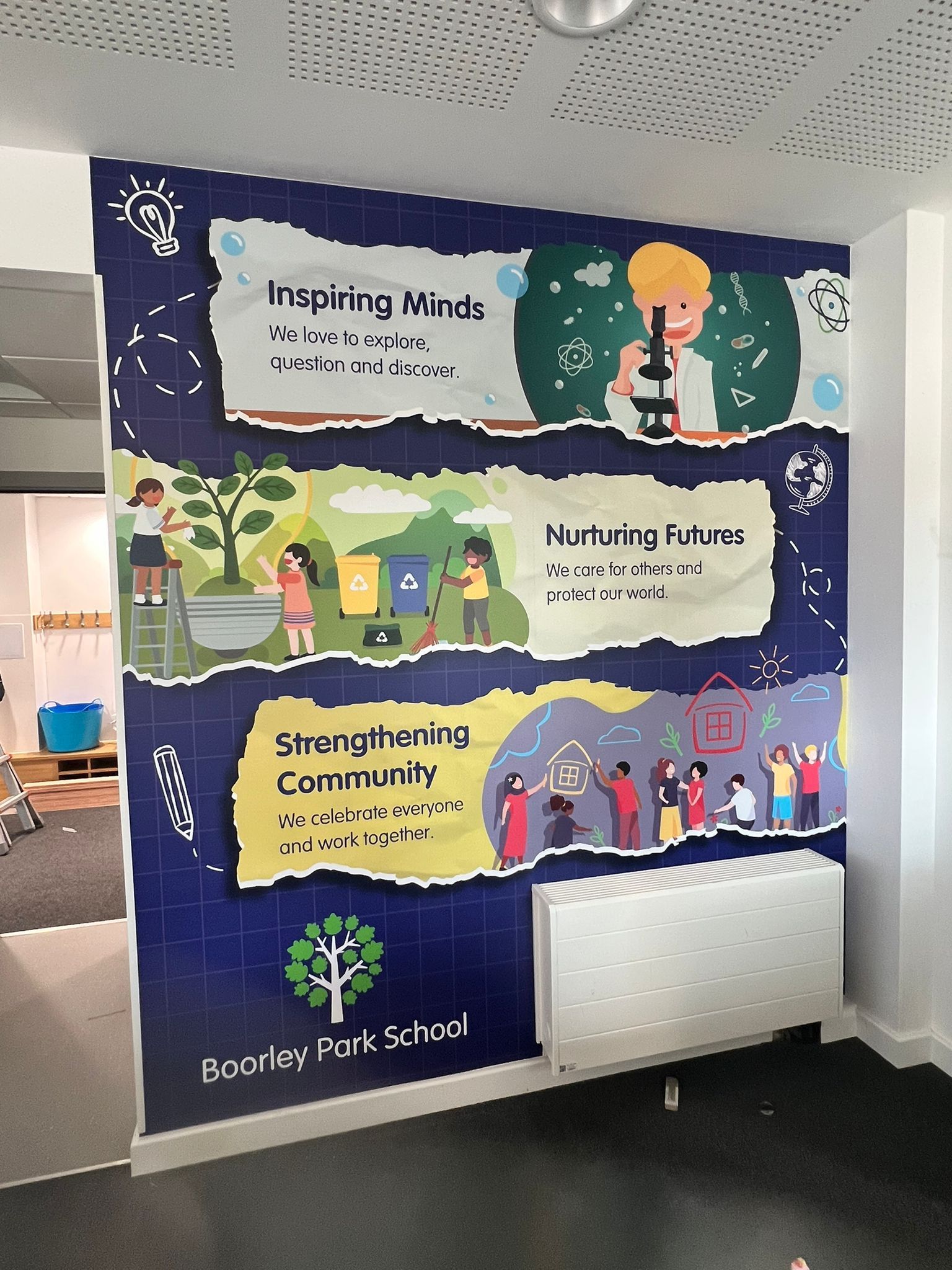
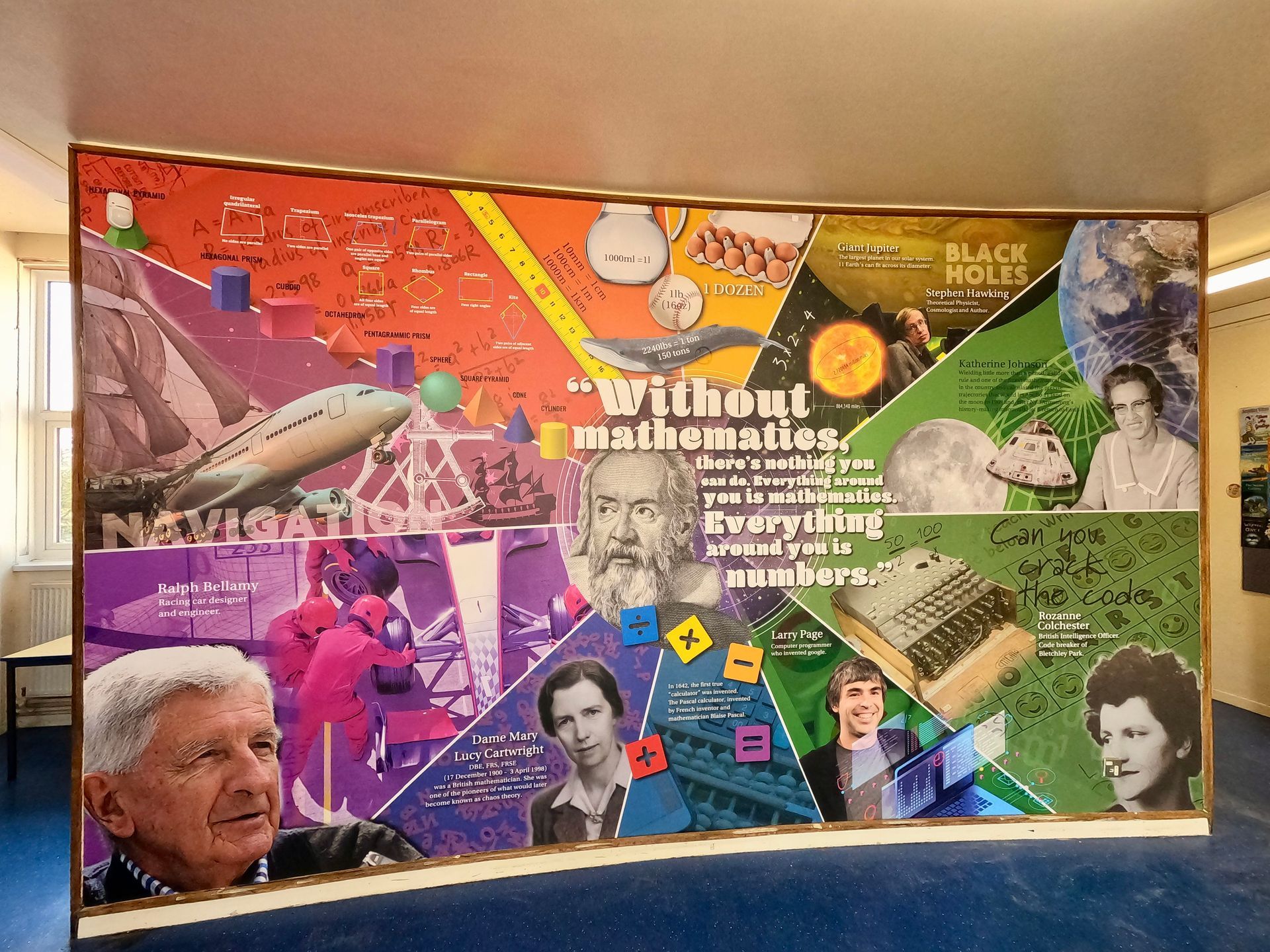
The walls of Boorley Park School now display multiple custom-designed wall graphics, which have transformed its corridors and shared areas into vibrant spaces.
The educational environment at the school features wall graphics that display learning content, discovery elements, and belonging messages to create daily inspirational spaces for students.
The World of Imagination and Learning
Creation:
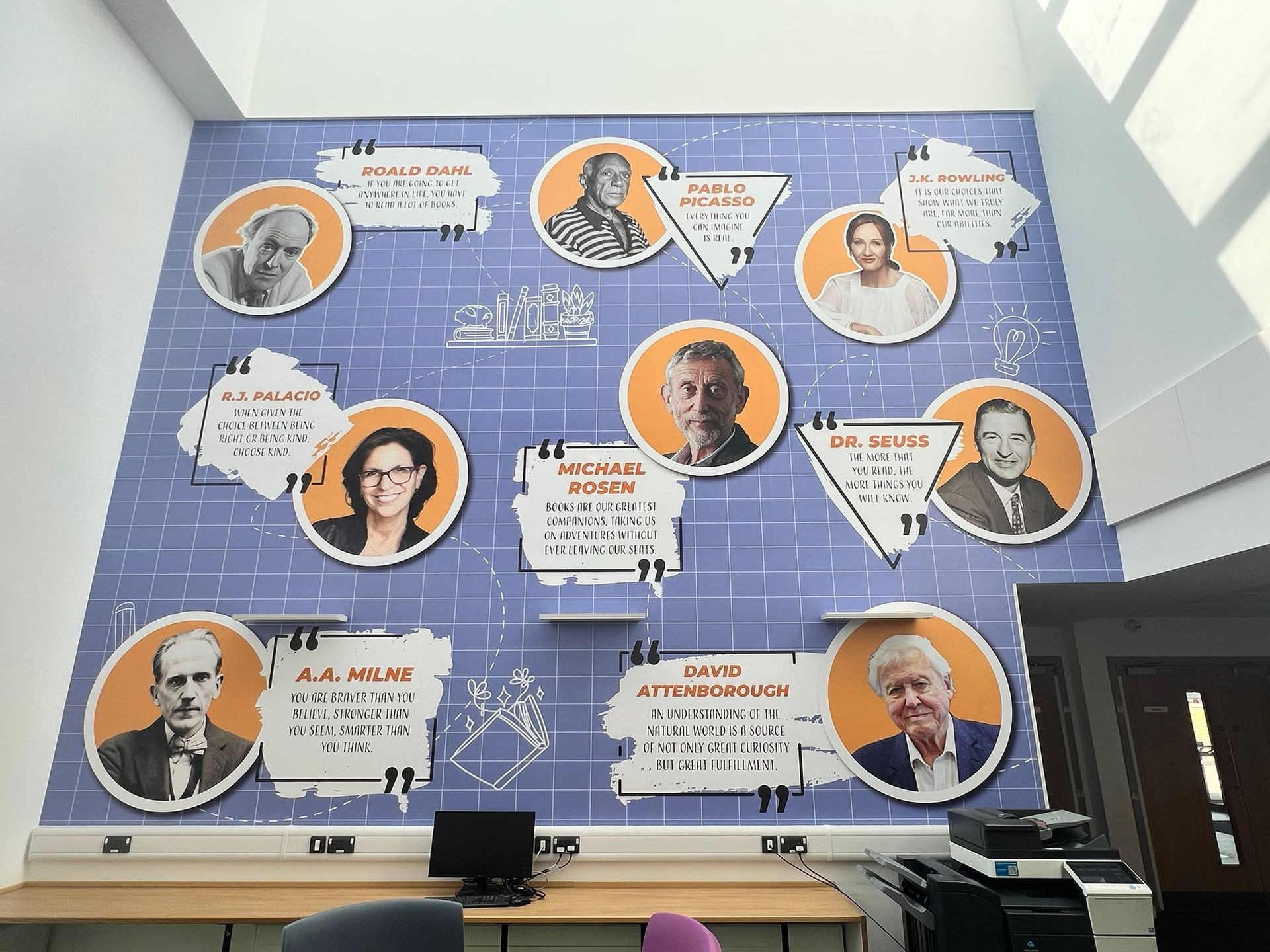
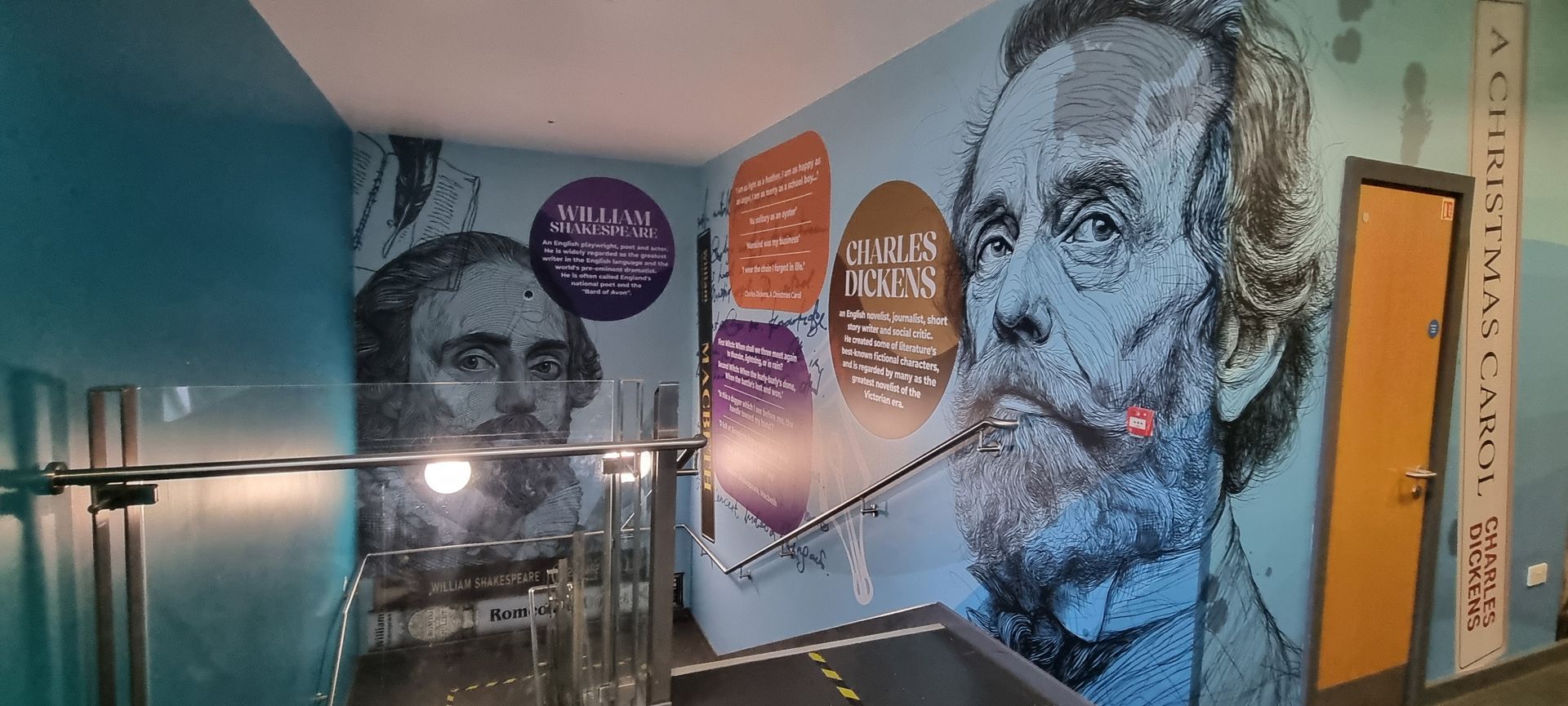
- The wall features portraits of inspirational thinkers, writers, and creatives alongside their most famous quotes to demonstrate the power of imagination and lifelong learning.
- The design unites contemporary illustrations with educational elements to transform the area into a celebration of creative expression and reading skills.
Educational Influence:
- The artwork motivates students to explore language and artistic and cultural subjects. The artwork motivates students to understand how their imagination leads to progress through their willingness to take risks and show curiosity.
- Teachers now use this display to lead classroom discussions about storytelling, creative expression, and student resilience.
The Geography of Connection
Creation:
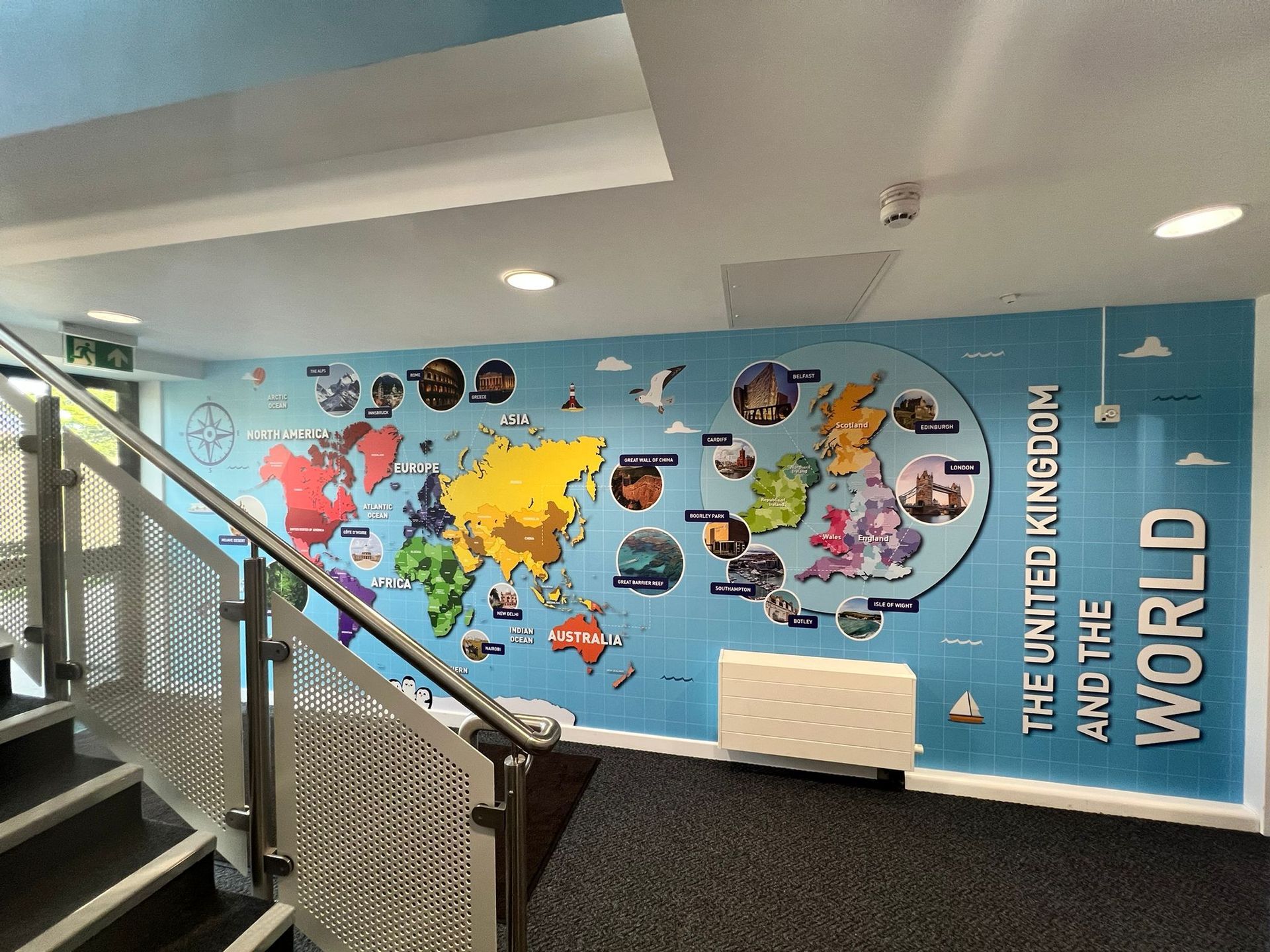
- The entire wall features a large world map, helping students understand the United Kingdom's position in the global context.
- The continents contain essential landmarks and images that establish connections between classroom geography education and actual exploration.
Educational Influence:
- The colourful map transforms the stairwell into an interactive learning area for students. Students use the map to explore global geography by finding cities and following routes, while understanding how different places and cultures connect.
The Belonging Wall
Creation:
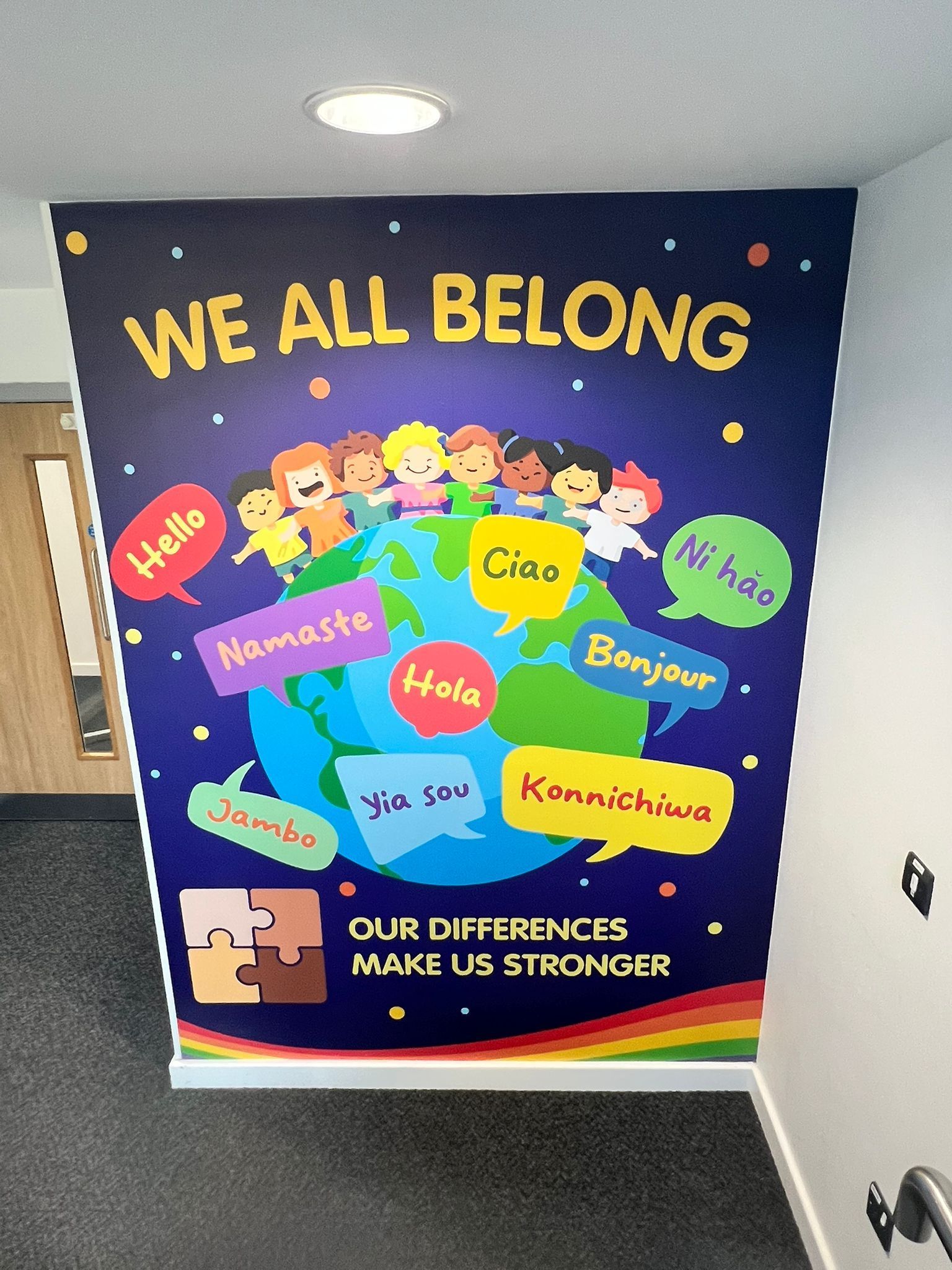
- The "We All Belong" mural presents a happy atmosphere which promotes friendship and inclusiveness for all. The mural features children from around the world who share greetings in various languages, surrounding a globe that symbolises unity and kindness.
Educational Influence:
- The design teaches pupils to develop empathy, respect, and understanding, which creates a strong sense of community. Students naturally interact with the words and languages which teach them about the power of communication to build relationships.
The History Timeline
Creation:
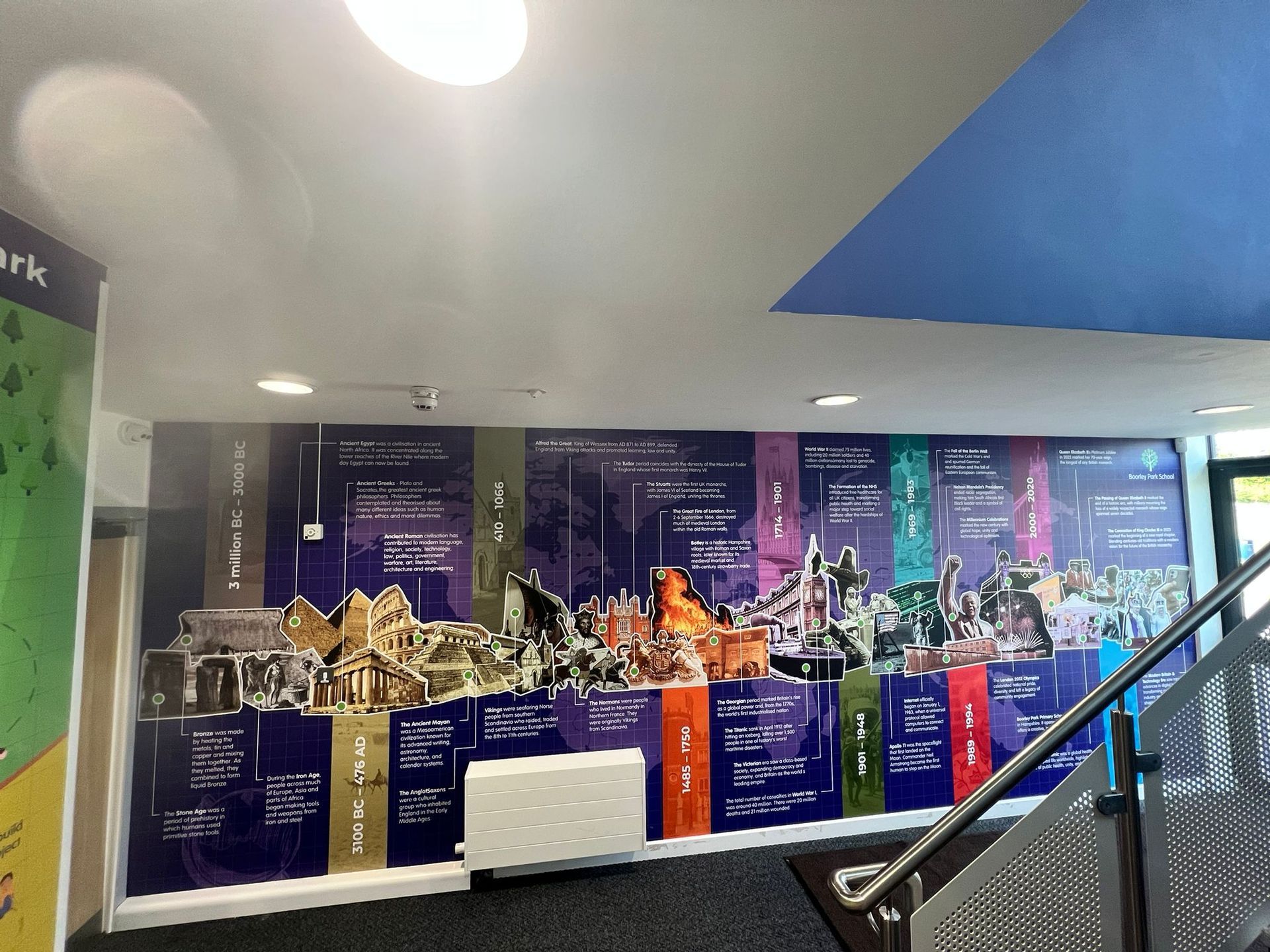
- A long corridor displays a detailed historical timeline of significant events from ancient times to the present day.
- The timeline features colourful sections that guide readers through human history, starting from ancient times until today.
Educational Influence:
- The design enables students to learn historical facts through visual narratives, which support their curriculum requirements. Students experience historical progression as they move from one grade to the next, which helps them develop their understanding of chronology and sparks classroom discussions.
The 50 Things Challenge Wall
Creation:
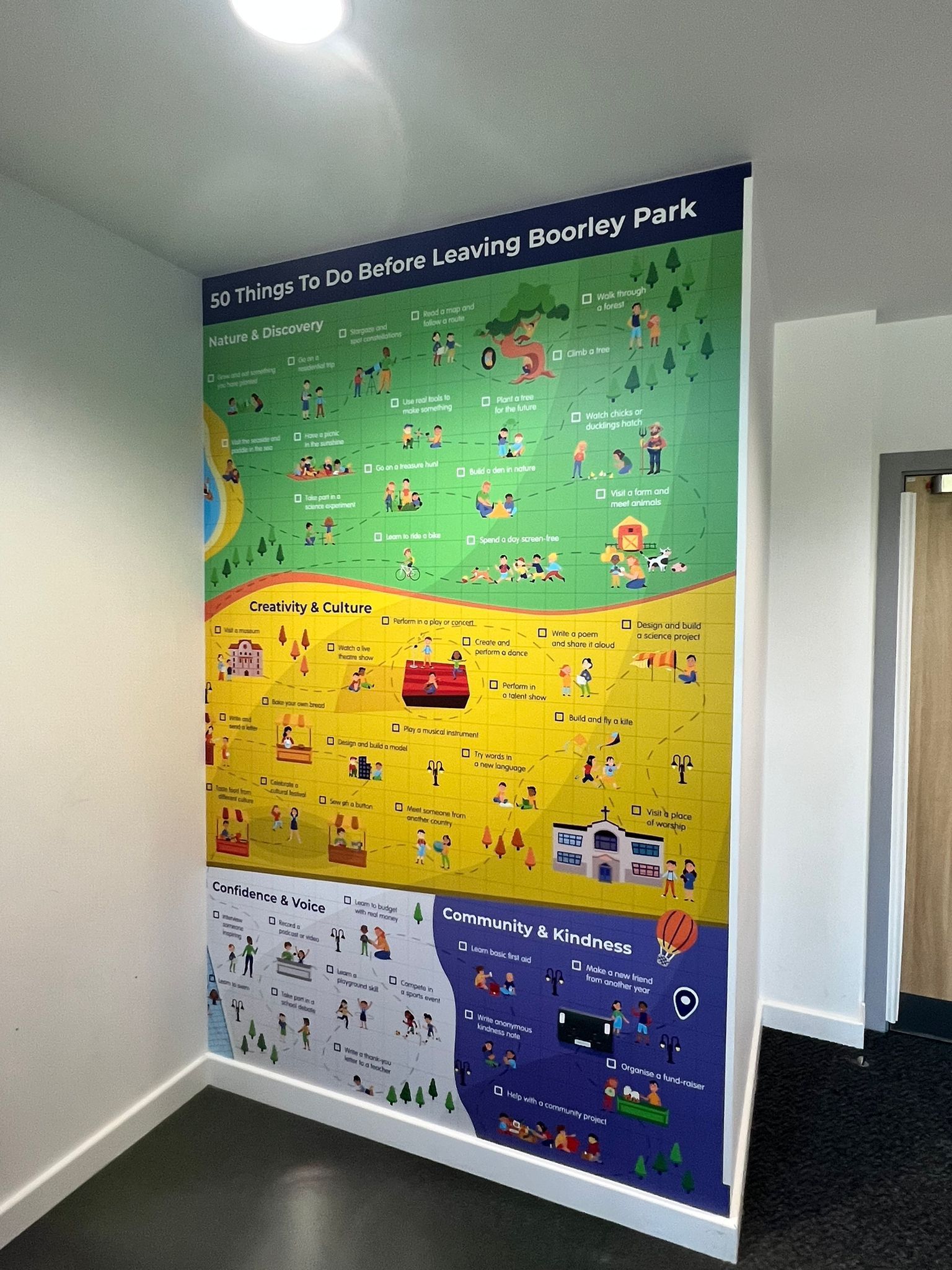
- The colourful checklist presents students with fifty activities to experience, including tree planting and stage performance.
- The illustrations and icons in the design make each activity appear both enjoyable and attainable, encouraging students to explore new experiences for personal development.
Educational Influence:
- The wall serves as a celebration of learning experiences which occur outside traditional classroom settings. The wall encourages students to develop self-assurance, creative thinking, and empathetic skills through real-life experiences, establishing positive learning habits for their future.
Result:
- The school environment has undergone a complete transformation because of these new wall graphics. The school corridors now serve as daily educational resources, featuring world maps and timelines, as well as content on creativity and kindness.
- The educational visuals will help teachers deliver better lessons while students develop enthusiasm for their learning environment.
- The project unites educational content with design elements to establish an environment which inspires students while promoting inclusiveness and discovery.
Conclusion:
- The wall graphic transformation at Boorley Park School demonstrates how educational visuals can unite the entire school community through inspiration and education.
- The educational designs enable students to understand that learning exists throughout their entire environment.
🌳 Every Cubed Creative project plants a tree — helping education grow greener.
School is back. The corridors are busy again. Pupils are moving between lessons. Staff are back in the rhythm of the day. Visitors are coming through the gates and down the hallways. That is when things stand out most. Blank walls feel more obvious. A tired entrance gives the same first impression as last term. The subject areas you meant to improve are suddenly back in view every day. If you want new school wall graphics installed during the next low-disruption window, the time to start planning is now. For many schools, October half term 2026 is when to do it . Dates vary by school, academy and region, so your own calendar must be checked first. The important point is simple: design, approval, production and installation planning all need to happen before the holiday begins. Why should you book your school graphics project now? You should book now because holiday installation slots are limited and the work involves more than printing a graphic and putting it on a wall. Starting early gives you time to make decisions properly, secure a suitable installation window and avoid competing for the same dates later. A typical project may include: A free site visit and accurate measurements We assess the walls, access points, doors, radiators, sockets, staircases and other practical details. Agreeing the creative brief This covers your school branding, curriculum priorities, values, colours, messages and the areas that matter most. Creating and reviewing artwork Our design team develops concepts for your corridors, reception, classrooms or subject zones. Making amendments Your team has the opportunity to review the design, request changes and ensure the final artwork feels right for your school. Final approval Nothing goes to print until the artwork and specifications have been approved. Printing and preparation Graphics are printed, finished, labelled and prepared for the installation team. Scheduling installers We plan the work around your term dates, INSET days, half terms, access arrangements and safeguarding requirements. Preparing walls and access Walls may need cleaning, filling, sanding, sealing or other preparation. Furniture and equipment may need to be moved before installation. That is why leaving everything until the last few weeks can make a suitable holiday slot difficult to secure. Book a free site visit now by calling 0208 804 5309 , emailing info@cubedcreative.co.uk or using the school graphics enquiry form . What can actually be completed in one holiday window? A focused project can make a noticeable difference in one holiday window. The best approach is to choose a defined area, prepare the artwork early and match the project size to the time available. Possible one-window projects include: A reception and entrance transformation with school branding, a welcome message, values, room identification and window films. One complete corridor featuring a curriculum-linked mural, history timeline, reading theme or subject graphic. A set of subject zones for areas such as maths, science, English, geography, music or sport. Stair risers using numbers, vocabulary, facts, motivational messages or school values. Door and room signage to improve wayfinding and create a more consistent visual identity. Window graphics for privacy, decoration, branding or a calmer atmosphere. A library or reading area using wall art for schools to create a stronger reading culture. The project does not need to transform every building at once. A well-planned entrance, one secondary corridor or a clearly defined primary school reception can create an immediate improvement.
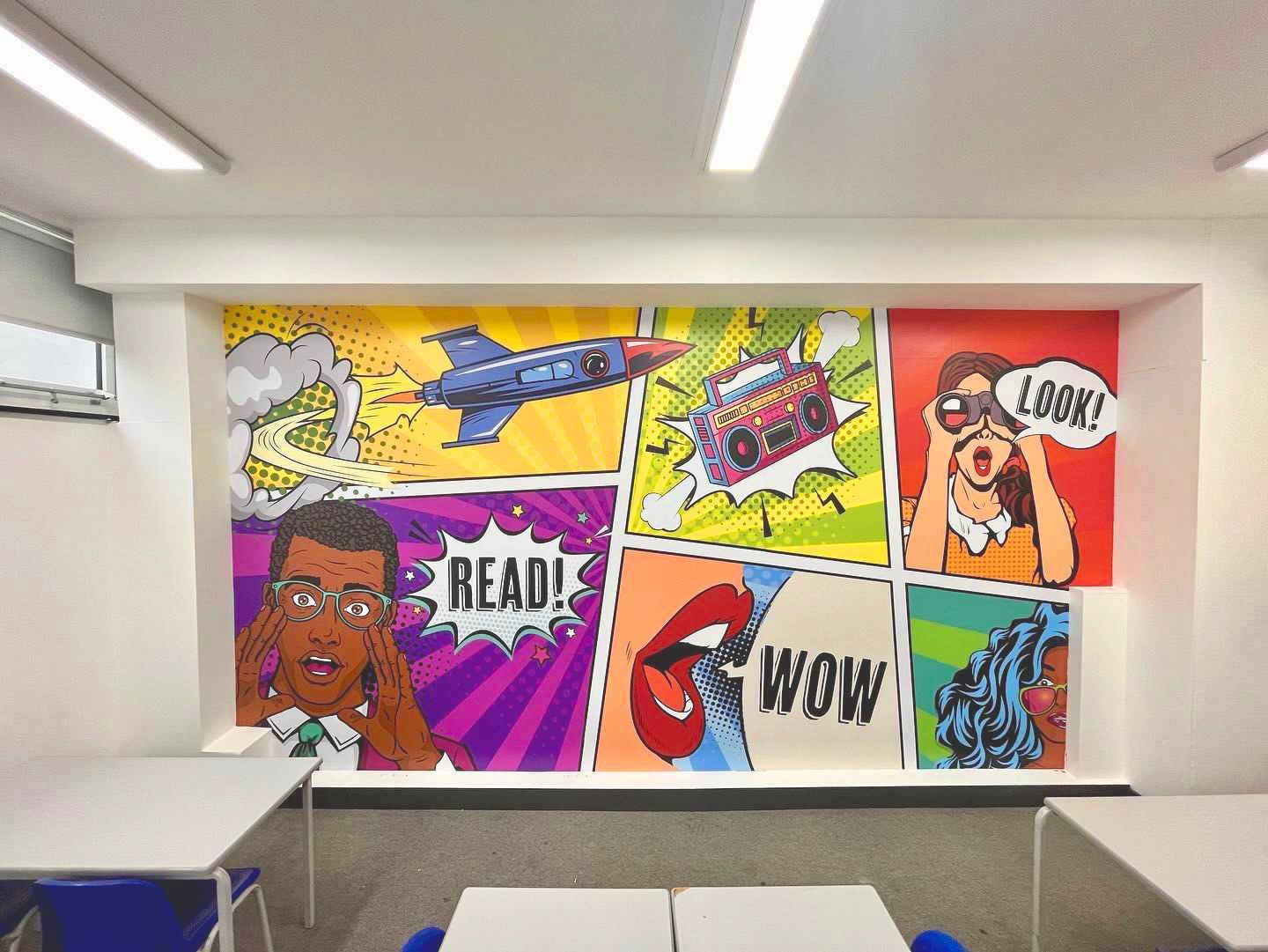
Walk down a typical secondary school corridor at ten past eleven on a Tuesday morning. What do you hear? Chatter, footsteps, locker doors slamming, the distant ring of a bell. What do you see? Scuffed magnolia paint, chipped corners, and hastily pinned notices peeling off tired pinboards. Now, step into a corridor transformed by bespoke wall graphics. The atmosphere shifts instantly. Pupils move with purpose. The space feels cared for. That shift isn't an accident of interior design. It is the direct result of colour psychology at work. Every hue on your school walls communicates something to the young minds passing beneath it. It calms anxiety, sparks curiosity, or, if neglected, induces boredom and restlessness. At Cubed Creative , with over 21 years of experience working closely with schools across London and the UK, we’ve seen how intentional colour choices reshape not just physical walls, but student behaviour and school culture. Let's look at what your corridor colours are really doing to your students and how to get them working for your school. The Science of Colour in Learning Environments Environmental psychology confirms what great educators have always known: physical surroundings shape cognitive performance and emotional well-being. When pupils transition between lessons, their brains process a constant stream of visual data. Colours trigger automatic neurological responses before conscious thought even takes place. Cool Tones (Soft Blues and Greens): These hues are neurologically linked to calm, sustained focus, and emotional regulation. They lower heart rates and reduce sensory overload, making them ideal for general circulation routes and zones near SEN or pastoral rooms. Warm Tones (Yellows and Soft Oranges): Energetic and stimulating, warm tones invite social engagement and creativity. However, when oversaturated or applied across entire walls, they can trigger agitation and shorten attention spans. Neutrals (Soft Creams and Pale Greys): They provide essential visual rest. Without neutral "white space," vibrant graphics lose their impact and hallways become visually exhausting.
Why Cubed Creative Is the Ultimate Choice for School Wall Graphics
Let’s be honest. When you walk into a top-tier private school, you feel it immediately. It’s in the air. The walls don’t just hold up the ceiling; they tell a story. They breathe excellence. But here is the secret most school leaders don’t realise: You don’t need a private school endowment to get that feeling. At Cubed Creative, we’ve spent 21 years working inside the UK education sector. We’ve seen the "before" and "after" of hundreds of state schools. We know that with a bit of strategy, the right materials, and a focus on high-impact areas, you can make a 1970s brick corridor look like a modern academy of the future. This isn't about spending more. It’s about spending smarter. Here is your insider guide to making your school look expensive on a state-school budget. 1. The "First Five Seconds" Rule You only get one chance to make a first impression. In the design world, we call this the "threshold experience." When a prospective parent, an Ofsted inspector, or a new pupil walks through your front doors, what do they see? If it’s a cluttered noticeboard with curled-up sugar paper and Blu-Tack marks, the "expensive" vibe is already dead. Focus your budget on the Reception and Entrance. Instead of ten small posters, go for one massive, floor-to-ceiling wall graphic . A single, high-quality focal point creates an immediate sense of scale and professionalism. It suggests that the school is organised, well-funded, and proud of its identity.
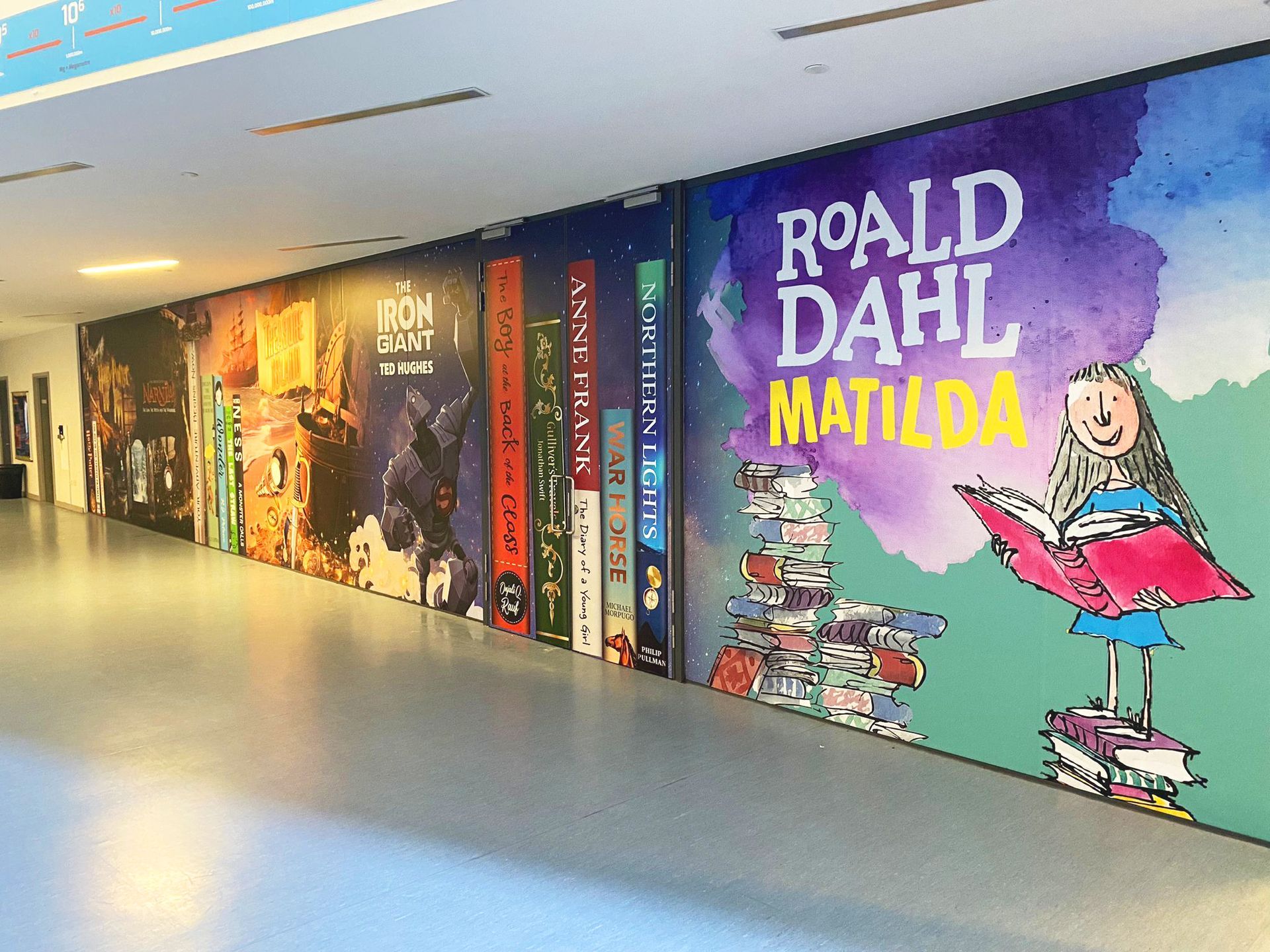
Summer is approaching. For school business managers and headteachers, this usually means one thing: the maintenance list. At the top of that list is almost always the corridors. They are the arteries of your school. Thousands of footsteps, bags dragging against walls, and the inevitable "scuff marks" that appear within weeks of a fresh coat of paint. You face a choice. Do you book the painters for another round of the "paint cycle," or do you look for a solution that actually lasts? At Cubed Creative, we’ve spent 21 years working inside schools. We’ve seen the difference between a corridor that is simply "clean" and one that is truly "inspiring." When you compare professional school wall graphics to fresh paint, the winner isn't just about aesthetics: it’s about your budget, your pupils, and your peace of mind. The Problem with the "Paint Cycle" We all know the routine. You spend a significant portion of your maintenance budget on a fresh coat of emulsion or eggshell during the summer holidays. By October half-term, the first scuffs appear. By Easter, the walls look tired again. This is the paint cycle . It’s a recurring expense that never actually solves the problem of a dull environment. While paint is the "standard" choice, it lacks the durability needed for high-traffic school environments. It doesn't offer protection against the daily wear and tear of a busy secondary school or the energetic movements in a primary hallway. More importantly, paint is silent. It doesn't teach, it doesn't guide, and it doesn't inspire. Why Wall Graphics Are the Long-Term Winner When we talk about wall art for schools , we aren't just talking about "stickers." We are talking about high-grade, laminated vinyl wraps designed specifically for heavy-duty use. 1. Durability that Defies the Corridor Our school wall graphics are finished with a protective laminate. This makes them incredibly tough. They are scuff-resistant and, perhaps most importantly for school staff, wipe-clean. Sticky fingerprints? Scuff marks from a backpack? They wipe right off. Unlike paint, which absorbs dirt and eventually chips, our graphics maintain their "just installed" look for years. When you look at the lifecycle cost, investing in graphics once every 5–7 years is far more cost-effective than repainting every year. 2. Turning "Dead Space" into Learning Space A painted wall is a missed opportunity. Corridors are the perfect place for passive learning . Imagine your pupils walking to their next lesson surrounded by a giant timeline of British history, or a literacy-themed corridor featuring the spines of classic novels. You aren't just decorating; you are teaching. By using bespoke wall art , you can reinforce the curriculum outside the classroom. From Science and STEM displays to school values and maps, the educational value is immense.
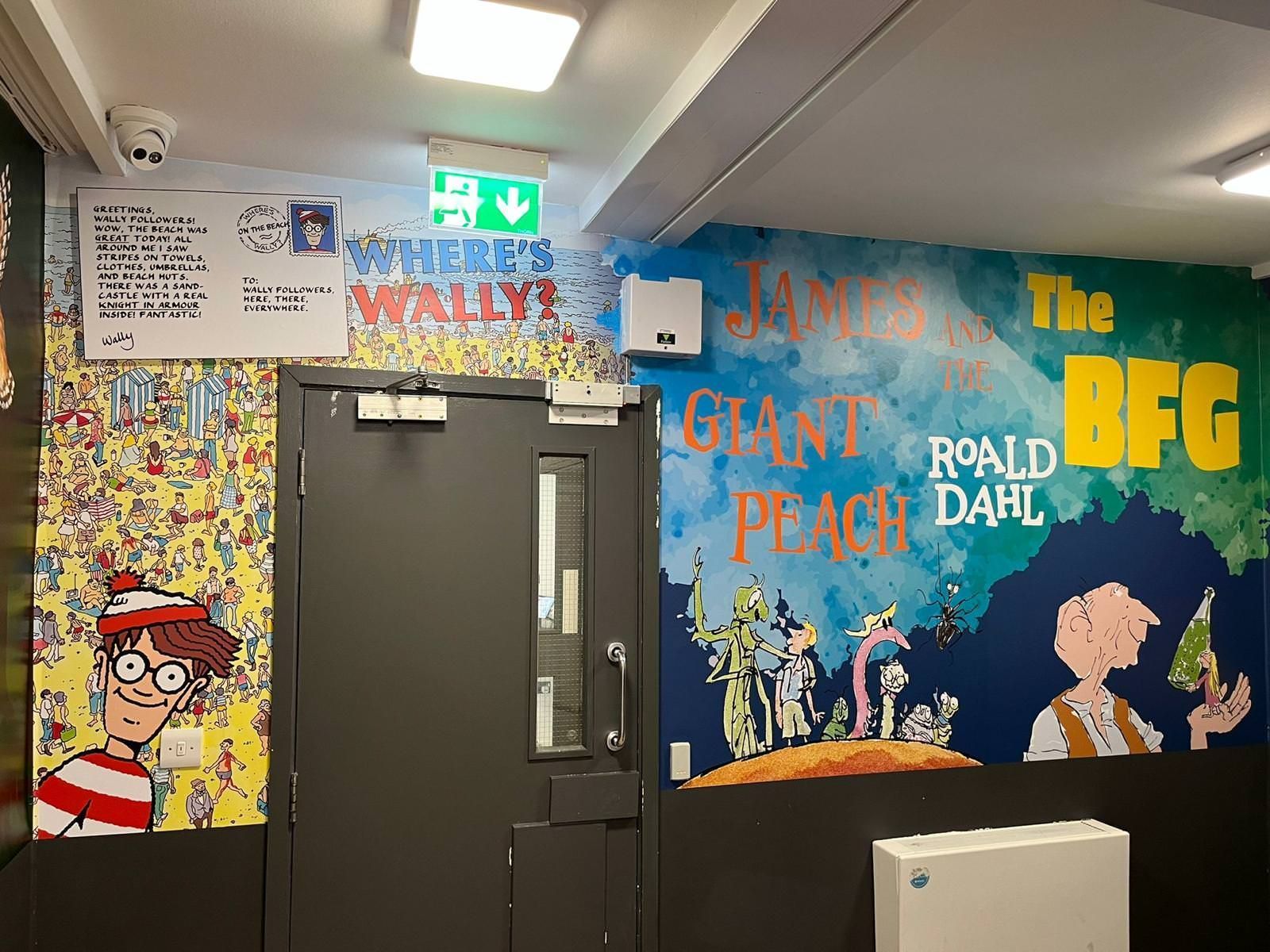
Walk through your school corridors during lesson time. It’s quiet. The doors are closed, and the heavy lifting of teaching is happening inside the classrooms. Or so it seems. But what about the walls around you? Those vast, often empty expanses of brick and plaster aren't just structural. They are constantly communicating. They are teaching, even when no one is speaking. In educational psychology, this is known as the ‘Silent Teacher.’ It is the idea that the physical environment: the colours, the displays, the signage, and the layout: shapes student behaviour and learning outcomes without a single word being uttered. At Cubed Creative , we’ve spent 21 years helping schools understand that their walls are their most underutilised educational asset. When you look at school wall graphics , you shouldn't just see decoration. You should see a pedagogical tool. The Psychology of the Learning Environment Your pupils spend roughly 15,000 hours in school across their academic journey. Most of that time is spent navigating the physical environment. The ‘Silent Teacher’ concept suggests that students are sponges for their surroundings. If a corridor is drab, grey, and cluttered with peeling posters, the message is one of low expectations and neglect. If that same corridor is vibrant, organized, and filled with bespoke wall art , it signals that the space: and the people in it: are valued. Reducing Cognitive Load There is a delicate balance to strike. Research into school behaviour and corridor design shows that while visual stimulation is vital, "visual noise" can be distracting. The key is intentionality. Purposeful visuals: Anchor charts, timelines, and key vocabulary support memory. Calming palettes: Blues and greens can help regulate energy levels during busy transition periods. Clarity: Clear, professional signage reduces anxiety by helping pupils feel oriented. Every graphic should "earn its place" on the wall. It must either inspire, inform, or guide.
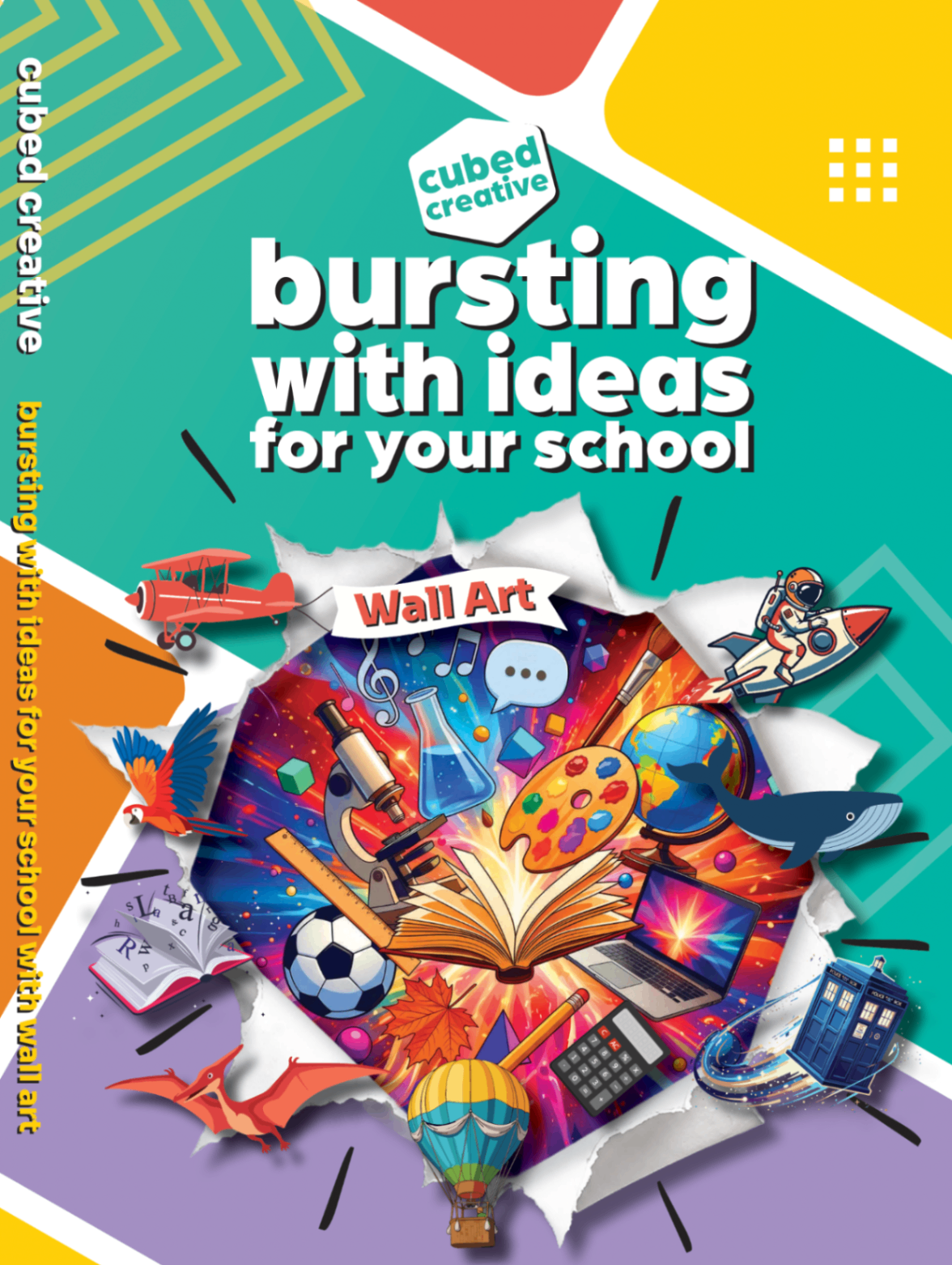
As we move through the middle of the school year, your thoughts are likely already drifting toward the summer holidays. Not just for the much-needed break, but for the opportunity it brings. When the corridors fall silent and the classrooms sit empty, your building finally has the chance to breathe. This is the window for the "September Reset" , that magical moment when students return to find their environment transformed, sparking a renewed sense of pride and curiosity. At Cubed Creative, we’ve spent the last few months working on something special to help you plan that transformation. We are thrilled to announce the launch of our brand new 2026 School Wall Art Brochure . It’s more than just a catalogue of past work; it’s the ultimate guide for a "September Reset" . It’s a toolkit for school leaders who want to move beyond tired noticeboards and plain magnolia walls. It’s packed with fresh inspiration, curriculum-linked designs, and the practical details you need to make a project happen during the summer break. Why Now? The Power of the September Reset The environment your pupils walk into on that first Tuesday in September sets the tone for the entire academic year. It’s a physical manifestation of your school’s expectations, its warmth, and its ambition. A "September Reset" isn’t just about making things look "pretty." It’s a strategic move to: Reinforce school values from the moment a child enters the gates. Reduce anxiety by creating calming, supportive spaces for wellbeing. Boost learning by turning "dead space" into passive learning zones. Improve behaviour through high-quality environments that show students they are valued. By planning your Summer wall art now, you ensure that all the heavy lifting: the design, the printing, and the installation: happens while the school is empty. You get the "wow factor" without any disruption to the school day. 21 Years of Creative Excellence When you’re looking for a partner to transform your school, experience matters. We’ve been working in the education sector for 21 years. Over those two decades, we’ve seen trends come and go, but our core mission has remained the same: to create environments that inspire. We understand the unique pressures of the UK education system. We know that budgets are tight, timelines are non-negotiable, and the materials used need to be "school-proof." Our 21 years of expertise mean we don’t just "put stickers on walls": we understand how to design for impact and install for longevity. What’s Inside the 2026 Brochure? The new brochure is designed to help you navigate the different ways wall art can support your School Improvement Plan. Here’s a sneak peek at the key areas we cover:
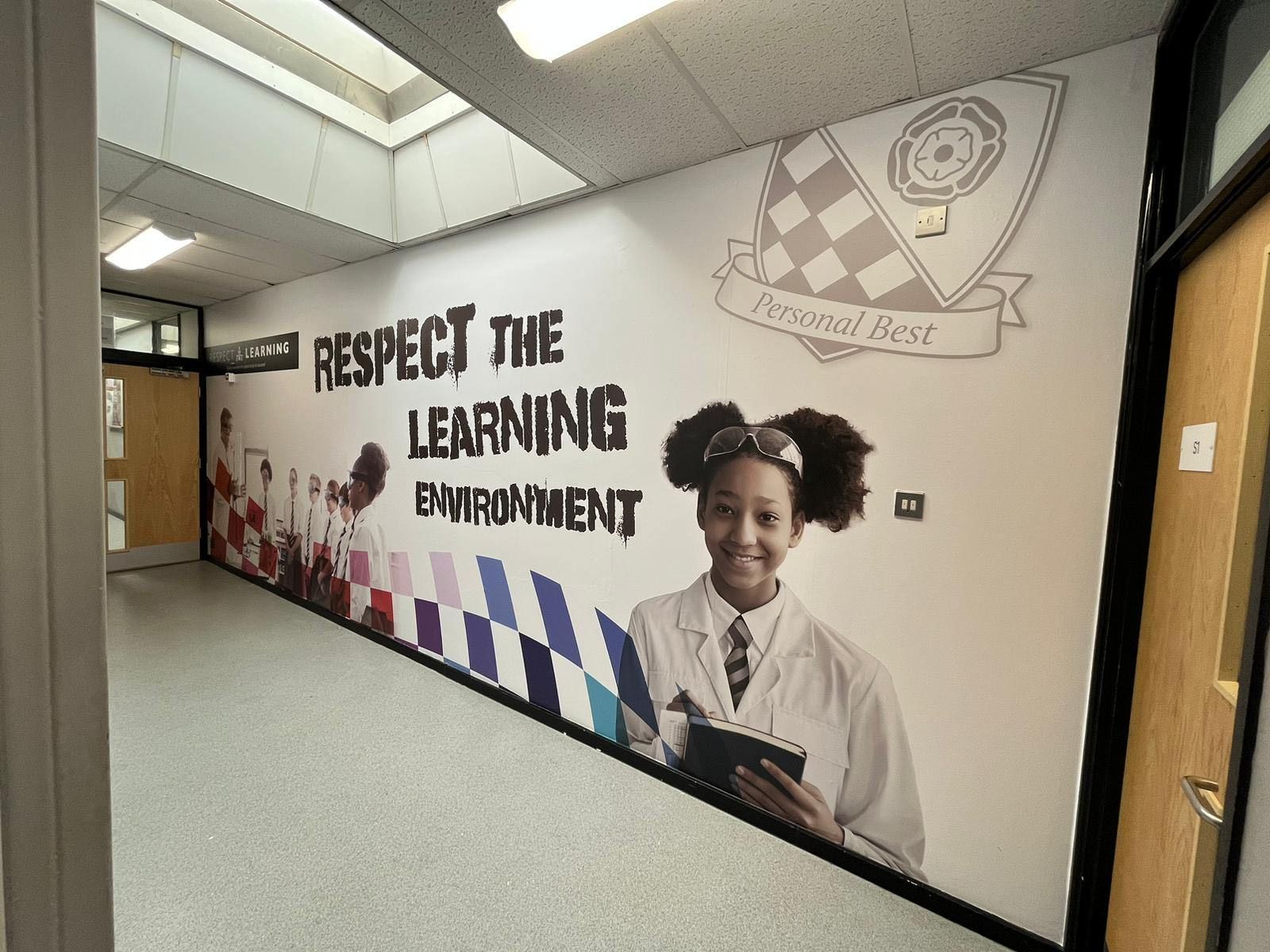
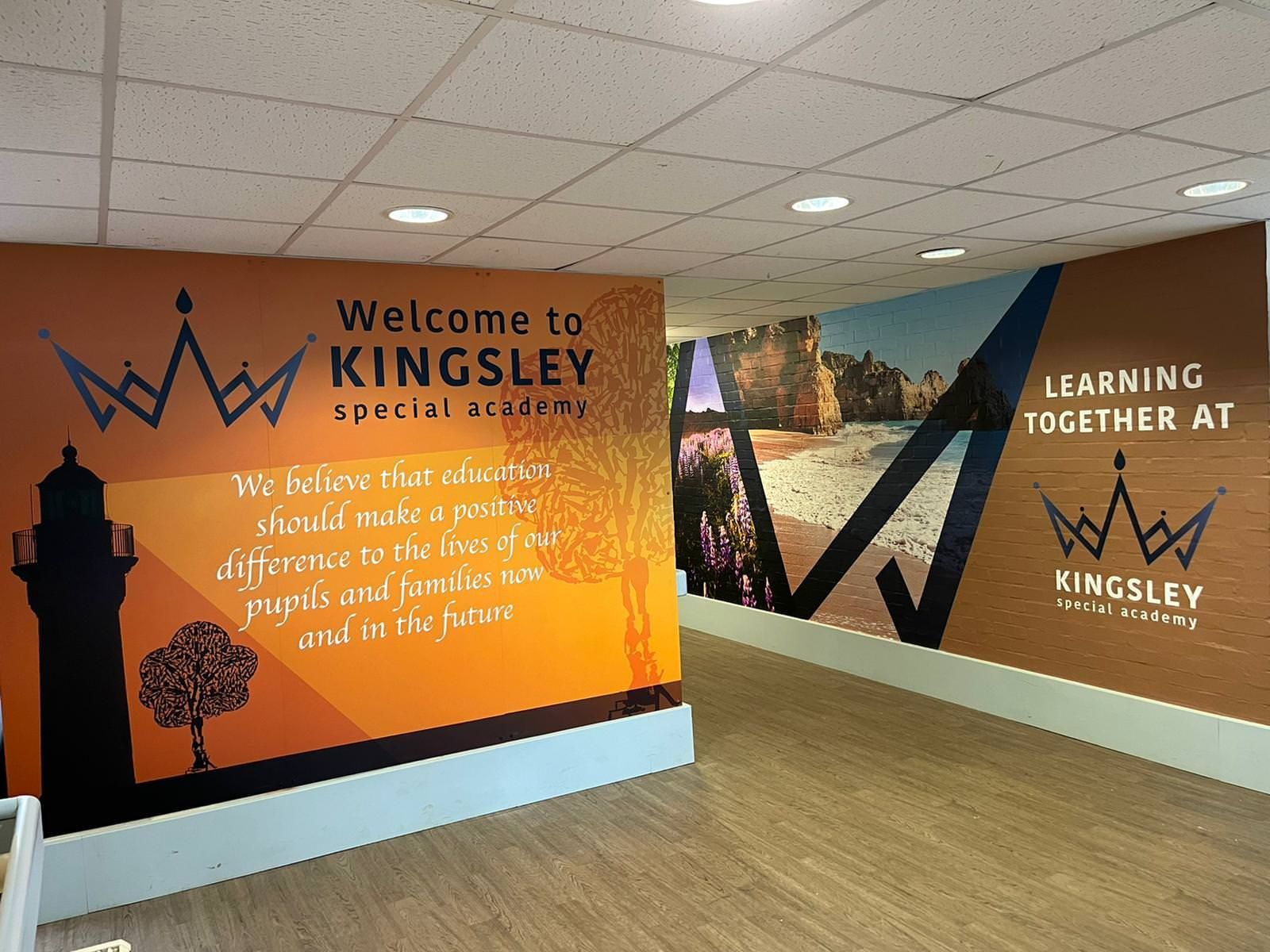
You’ve seen it before. A beautiful, vibrant wall display that looked incredible on the day it was installed. Fast forward six months, and the edges are starting to curl. A year later, it’s peeling away at the corners, or the vibrant blues and reds have started to look a little tired and faded. In a busy school environment, "good enough" usually isn't. When you are looking to transform your school corridors, reception areas, or classrooms, it is easy to focus entirely on the design. After all, the design is what tells your story. It’s what inspires your pupils and impresses your visitors. But the material those designs are printed on? That is what determines whether your investment lasts for a decade or ends up in the bin before the next OFSTED inspection. At Cubed Creative , we’ve spent 21 years working inside schools. We know that a corridor isn't just a walkway; it’s a high-traffic zone where hundreds of blazers, backpacks, and wandering hands pass by every single hour. Choosing the right school wall graphics materials is the difference between a long-term asset and a short-term headache. The Science of the "Shrink": Monomeric vs. Polymeric Vinyl If you’ve been gathering quotes for school wall graphics , you might have noticed a significant range in pricing. Often, the "cheaper" quotes are using what we call Monomeric vinyl. To keep it simple: vinyl is made of plasticisers. In monomeric vinyl, these molecules are short and "unbound." Over time, especially when subjected to the fluctuating temperatures of a school building, these molecules migrate. The result? The vinyl literally shrinks. When vinyl shrinks on a wall, it pulls away from the edges. It leaves a sticky, unsightly residue that attracts dust and dirt. It looks poor, and more importantly, it becomes a target for inquisitive fingers to pick at. This is why we champion polymeric vinyl school graphics Polymeric vinyl is engineered with longer molecular chains. It is far more stable. It doesn't shrink, it doesn't curl, and it stays exactly where we put it. It’s the gold standard for long-lasting school wall displays . When we talk about durability, we aren't just talking about the print staying bright; we’re talking about the material staying bonded to the wall.